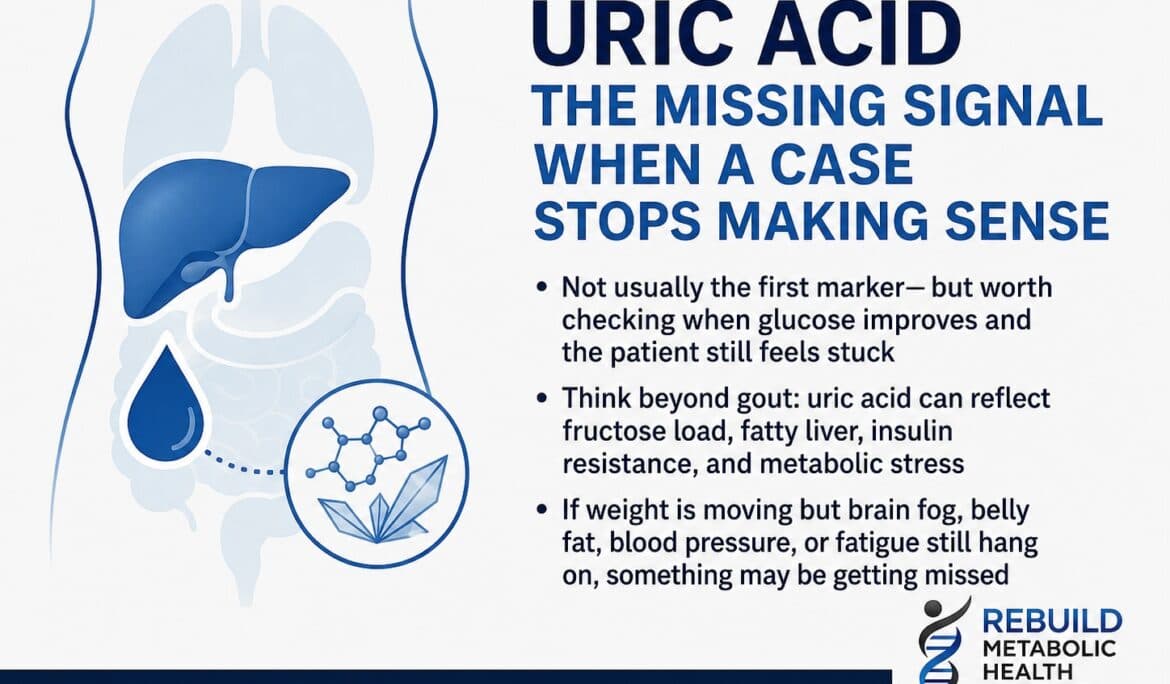
There is a pattern I keep seeing in clinic that does not get enough attention.
A patient's glucose is improving. Their appetite is down. Their weight is moving. Sometimes they are already on a GLP-1. Sometimes they are already working on hormones, sleep, and body composition. On paper, the case looks like it should be moving in the right direction.
But when you sit across from the person, the story feels different.
They still look inflamed. Their energy is flat. Their thinking feels slower than it should. The fat around the middle is hanging on. Blood pressure is creeping. Fatty liver is still in the picture. The numbers are improving, but the person does not feel like they are actually getting well.
That is usually the point where I start thinking beyond glucose.
One of the markers that becomes more interesting to me at that stage is uric acid.
Uric Acid Is Not Usually My First Move
To be clear, uric acid is not usually my first move.
If someone comes in for hormone work, metabolic dysfunction, or GLP-1 support, I am still starting where I start: glucose and insulin patterns, thyroid function, sex hormones, inflammation, liver markers, body composition, sleep, and gut and bile function.
That is still the front door.
But once those issues are already being addressed, and the case still feels sticky, uric acid can become a very useful part of the story.
That is where I think it belongs clinically.
Not as the headline on day one. Not as something everybody needs first. But as a secondary signal when the optimization process is already underway and something still is not adding up.
The False Win in Modern Metabolic Care
One of the biggest mistakes in this space is assuming that one visible win means the whole system is better.
Glucose improves, so everyone relaxes. Weight comes down, so everyone assumes the chemistry underneath must be fixed. Appetite drops on a GLP-1, so the case gets labeled a success.
But biology does not work that way.
You can improve glucose and still have a metabolism under pressure. You can lose weight and still have fatty liver biology. You can eat less and still not be feeding the cell the right way. You can suppress appetite and still leave the deeper chemistry untouched.
That is why some patients look better on paper and still feel off in real life.
Uric Acid Is Bigger Than Gout
Most people still hear "uric acid" and think gout. That is too narrow.
In the right patient, uric acid can be part of a much larger story involving fructose load, liver congestion, insulin resistance, vascular tension, dehydration, low muscle mass, poor kidney clearance, and incomplete metabolic recovery.
That is why I care about it.
Not because it explains everything. Not because it replaces the basics. But because it can help explain the patient who says, "I'm doing everything right, but I still feel off."
Why This Matters More in the GLP-1 Era
This matters even more right now because of how many patients are using GLP-1 medications.
Many of them do lose weight. Some do better quickly. That can absolutely be a major step in the right direction.
But weight loss and appetite suppression do not automatically mean metabolic repair.
Already on a GLP-1 — and still feel stuck?
If your glucose and weight are moving but the rest of the picture still feels off, the next step is a real metabolic conversation. Travis works through the secondary signals — uric acid, liver, hydration, muscle, sleep — that explain why the case is incomplete.
Book a ConsultationI see patients eating less, but not necessarily eating better. Some are under-hydrated. Some are under-muscled. Some are still leaning on alcohol, processed "healthy" foods, or fructose-heavy choices that never really left the picture. Some are lighter on the scale, but still look metabolically slow in the room.
That distinction matters.
Because losing weight is not always the same thing as getting metabolically healthier.
This is one reason uric acid can become useful. It helps me ask whether the person is truly getting better, or whether one piece of the case is improving while the deeper terrain is still working against them.
The Better Question to Ask
When uric acid is elevated, the first question should not be: How do I lower the number?
The better question is: Why is it high in this person?
That pushes the case in a much smarter direction.
Now I am thinking about fructose. Alcohol. Fatty liver. Dehydration. Low muscle mass. Insulin resistance. Renal clearance. Sleep disruption. Overall metabolic resilience.
That is a very different conversation than simply reacting to a lab.
Because in my world, I am not trying to "treat uric acid." I am trying to fix the terrain that keeps pushing it up.
What I Do When It Shows Up
When uric acid appears to be part of the problem, I am usually not reaching for something exotic first.
I pull back fructose and liquid sugar. I tighten alcohol. I improve hydration. I work on muscle. I clean up sleep. I keep working insulin sensitivity. I make sure the patient is actually rebuilding metabolic health, not just eating fewer calories.
That is the real work.
And when that starts happening, the wins become much clearer.
The Wins I'm Looking For
I am not just looking for a prettier uric acid number on the next lab draw.
I am looking for the person to actually change.
I want to see steadier energy, less stiffness, less puffiness, less belly fat, better blood pressure, cleaner liver markers, better body composition, and a patient who feels like their metabolism is finally moving in the right direction.
That is the outcome that matters.
Because the goal is not simply to lower uric acid. The goal is to change the metabolic environment that kept driving it there in the first place.
Final Thought
Uric acid is not the first marker I chase.
But when hormones are being addressed, glucose is improving, appetite is down, and the patient still feels metabolically stuck, it becomes a very useful part of the story.
That is why I pay attention to it.
Because sometimes the missing piece is not more restriction, not more appetite suppression, and not another supplement. Sometimes it is the chemistry nobody thought to revisit once the obvious markers started improving.
And for a lot of patients, that is where the case finally starts making sense.
Medical disclaimer: This article is for educational purposes only and does not constitute medical advice. Individual clinical decisions should be made in consultation with a qualified healthcare provider following appropriate evaluation. References to specific treatments, dosing, or protocols are informational.
Travis spent 17+ years in high-acuity clinical medicine — emergency, cardiac ICU, and cath lab — before founding Revitalize. He is a Certified Platinum Biote hormone therapy provider, the published author of You're Not Broken — You're Unbalanced, and the founder of the Rebuild Metabolic Health Institute. His clinical writing reflects the same precision he brought to critical care: specific, honest, and built around what actually works.